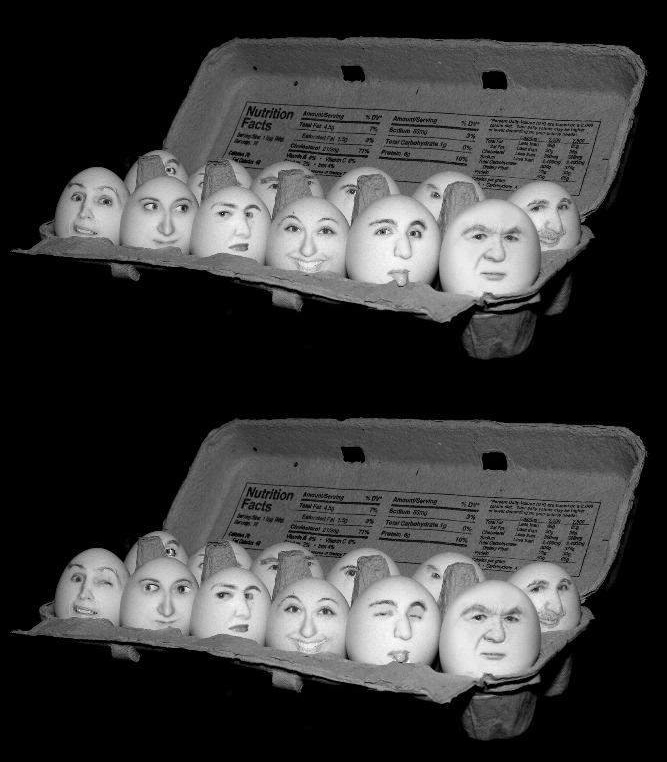
ethnocentricity... the self-medicated attitude or philosophical position of being members of the only party that knows the way everything is supposed to be done. group arrogance.
well we certainly get tagged with this one from time to time... especially we pastor types!
in the 70's and into the 80's there was a christian band called
daniel amos that epitomized the phrase
mainstream alternative for a bunch of us christian kids who were looking for something artistic
and Christ honouring (at the time it was basically an either-or scenario... if you wanted to be 'spiritual' then you pretty much had to check your aesthetics at the door)
. originating at calvary chapel under the spiritual toutelage of rev. chuck smith-
but don't hold that against them- this band started as an eagles-esque cowboy band, moving through three or four creative stages in as many albums, hitting some really satisfying homages to their influences (
beatles, bowie, electric light orchestra,b52's and talking heads a'la eno) along the way.
(http://www.danielamos.com/main.html)
there was a song on volume 1 of the
alarma chronicles that addressed the whole worship ethos and its inherent ethnocentricity from a satirical, new wave point of view
(note: i've focused on the content aspects of the lyrics, and have cut out the stuff that only works on record...)
you might not recognize, the truth gets colored by
wrong things, bad things do disguise
afraid you might despise the real thing
the real thing...
down in southern cal we don't wear shoes
we lay it way back
when someone with charisma tells me "don't wear shoes"
i tell them "go back- where did you get that?"
down in africa they beat the drum
they like the big beat
white man through the p.a. says "don't beat that drum"
they tell him "go back- where does it say that?"
the real thing...
down at the little church they all wear hats
they feel they're doing right
over at the big church they hate those hats
it get's them uptight- now is that right?
you might not recognize, the truth gets colored by
wrong things, bad things do disguise
afraid you might despise the real thing
the real thing... -terry taylor
the whole
worship style discussion is so totally old that, about halfway through its history, even Jesus got into it. remember the whole whip-wielding 'house of prayer/ den of thieves'
(citing isa56.7/jer7.11 in matt21.13) thing? what was it really about- making money off of the poor or turning tennets of worship into something to be done for fun and profit? i think that it was the latter.
the poor were being exploited by everyone before, during, and after Jesus walked the earth. Jesus even spoke to the disciples about it at bethany
(in matt26.11 and mark14.7) it's not that he didn't have a heart for the poor- his acts of mercy (healings, feedings, fellowship and the like) are examples of this heart for social justice. however, Jesus also didn't go through the temple with a bullwhip on behalf of the poor who could not afford the extortionate prices of sacrificial animals or the over-the-top exchange rates... he tore the place apart on behalf of Holiness because the temple was meant to be a place of worship and communion with almighty God according to scripture, and the temple officials who had seen an opportunity to turn something that was to be about God into something that directly benefitted them had
carpe diemed their way to the bank. Jesus' anger burned because they were stealing from God, not from each other.
scripture records some pretty powerful examples of similar attitudes and actions in the name of piety... it's usually messy.
(1sam2-4; acts5) it seems that embezzling from God is a pretty serious deal. why? because in this thievery we see satan's agenda clearly. anytime someone slips some of God's glory into his or her own back pocket, satan's lurking around there somewhere.
okay, so here's where i'm going: is our self-centred flippancy towards the things of God within our contemporary worship experience so great that we die over it? perhaps not to the point that we are actually aware of it,
but is awareness definitive? do we have conditions placed upon us that exist before we are aware of them? think of the incubation period of a disease or virus, dormant or remissed cancer cells, arterial blockages not yet diagnosed.
remember the bruce willis film
6th sense, or a close celluloid relative called
the others starring nicole kiddman? in both films, people are carrying on life as usual and we only discover through a couple of fun little twists that actually they've been dead the whole time and didn't know it. there is a form of reverse dramatic irony here, which my son and i refer to as a
shyamalon twist (after the acclaimed young director of
6th sense,
unbreakable,
signs and
the village) where the audience joins the principal characters in not knowing the crucial piece of truth around which the whole story is wound until a revelation in the final reel.
well what if we are all struck spiritually dead the moment we embezzle from God and, because we don't experience a lightning bolt from on high or something, we think that we're fine?
it is conceivable. in genesis 3 (yep, i'm back there again) the snake whispers that eve won't die if she samples some rebellion. whatever her inference or understanding of death (after all, literal interpretation of the scriptures holds that nothing had died yet) she tastes, looks around to see if anything has changed and then, seeing that she is fine, kills her life's partner too. no worries- he doesn't know it either.
but in that instant the physical and the metaphysical are rent apart. physical bodies begin to die and perspectives begin to cloud. it is now only a matter of time until the body catches up to what the soul is already experiencing and dies too. from that moment on, death becomes part of worship and sacrifices are offered, that the purity of the perfect animal can be exchanged before God for the sin of the one offering the animal- bringing new spiritual life and a fresh new day for the sinner.
Jesus railed in the temple because these religious capitalists were dead people making the very house of God an abomination in the eyes of both God and man. they were taking something that God had set up to ford the gap between the holy and the common and were turning it into something that would repel anyone who had not been raised in that tradition. it's like everyone knew they were dead except them- everyone knew that this place was no more the house of God than the public baths were a place to get cleaned up.
the romans knew it.
the greeks knew it.
the homosexuals knew it.
the prostitutes knew it.
the addicts knew it.
the lepers knew it.
even the blind who begged at the city gates could see with their sightless eyes what the ethnocentrically religious could not... that their so-called worship was an embarrassment to everyone and everything holy because it was all about themselves.
the same is often said of the church today
. the hypocrisy evident in the body of Christ is still the most cited reason for
achristians to remain that way. in a recent study published over easter in our local paper, i read how only 17% of canadians interviewed in the week prior to
holy week admitted to regularly attending church, but that 62% agreed with the statement "through the life, death and resurrection of Jesus, God provided a way for the forgiveness of sins." why the numerical discrepency? it appears as though the majority of canadian people still believe in the God, but have trouble believing in the value of a corporate worship experience. are we a nation of beer-drinking mystics, or do we just tend to mistrust other people... particularly when they are part of something institutional? whatever the reason for it, the discrepency between those believing and those joining with others who believe is one with powerful implications upon both the unity of the body of Christ and the potential impact of this body upon the darkened world to which it has been trusted to bring the light of the gospel.
however, this is nothing new. we all know this.
as part of the comment box that spawned this post,
made a typically poignant and poetic observation:
Today, on this spinning ball of dirt, there are a lot of folks who worship our Lord, pray to our Lord, tell stories of our faith, in many different ways. We have Korean churches, and Catholics, and messianic Jews, and the 1,001 other approaches... In the past there was the early church, the medieval churches, the Renaissance, the modern age, the post modern era... and someday we will all share a single reality together. Heaven will be diverse.
So, if we are uncomfortable with some folks speaking in tongues, and others singing very serious, dirge-like hymns, what will happen in our hearts and minds when we are mixed together in one huge congregation?
Are we ready for it?
good question. i think that it is one that believers in Christ need to sort out for themselves. for me the answer has been found in a prayer and personal worship discipline. you see, when i wasn't listening to daniel amos, i was learning how to worship with the recordings of john michael talbot.
(http://e-pistles.blogspot.com/2006/01/simplicity-and-four-dollar-perspective.html) a song that i use regularly as a prayer a quarter-century later, particularly in times when i am tempted to ethnocentrically judge and therefore embezzle, is one of his:
create in me a clean heart o Godlet me be like you in all my waysgive me your strengthteach me your songshelter me in the shadow of your wingsfor we are your righteousnessif we've died to ourselves and live through your deaththen we shall be born again to be blessed in your loveLabels: ethnocentricity, gay, justice, other, worship